Technology
6/17/26
A Clearer Path for Community Operators: SSV VO, Lido CSM, and ICS

Build validator reputation with Lido CSM, SSV VO and ICS
For many independent node operators, the hardest part is not learning how to run validator infrastructure. It is getting the first real opportunity.
To become a trusted operator, you need validator performance history. But to build validator performance history, you first need access to a validator, either by having 32 ETH to run one yourself or by receiving delegated stake through a system like Lido CSM.
That creates a frustrating loop:
No validator history makes it harder to build a reputation. <> No reputation makes it harder to receive delegated stake. <> No delegated stake makes it harder to build history.
This is one of the most common bottlenecks for new community operators who want to grow from technically capable participants into recognized Ethereum node operators.
An update that started from a proposal on the Lido Research forum is now live in Lido CSM. It helps reduce that friction by connecting three existing parts of the Ethereum staking ecosystem:
The result is a clearer path for community operators to build mainnet experience, become SSV Verified Operators, and use SSV-based signals toward Lido ICS recognition.
The first-validator bottleneck
SSV Network is an open protocol. Stakers can choose the operators they want to run their distributed validator with.
That openness is powerful, but it also creates a challenge for newer operators.
Stakers naturally prefer operators with a proven track record. They want reliability, consistency, and strong performance. That is why SSV maintains a Verified Operator list, curated through the SSV DAO and the Verified Operator Committee.
For an operator, becoming a Verified Operator is a strong reputation signal. It shows that the operator has been reviewed and has demonstrated the kind of reliability stakers look for.
But to become a VO, operators need real mainnet performance history. And to get that history, they need validators. This is where Lido CSM can help.
Where Lido CSM fits
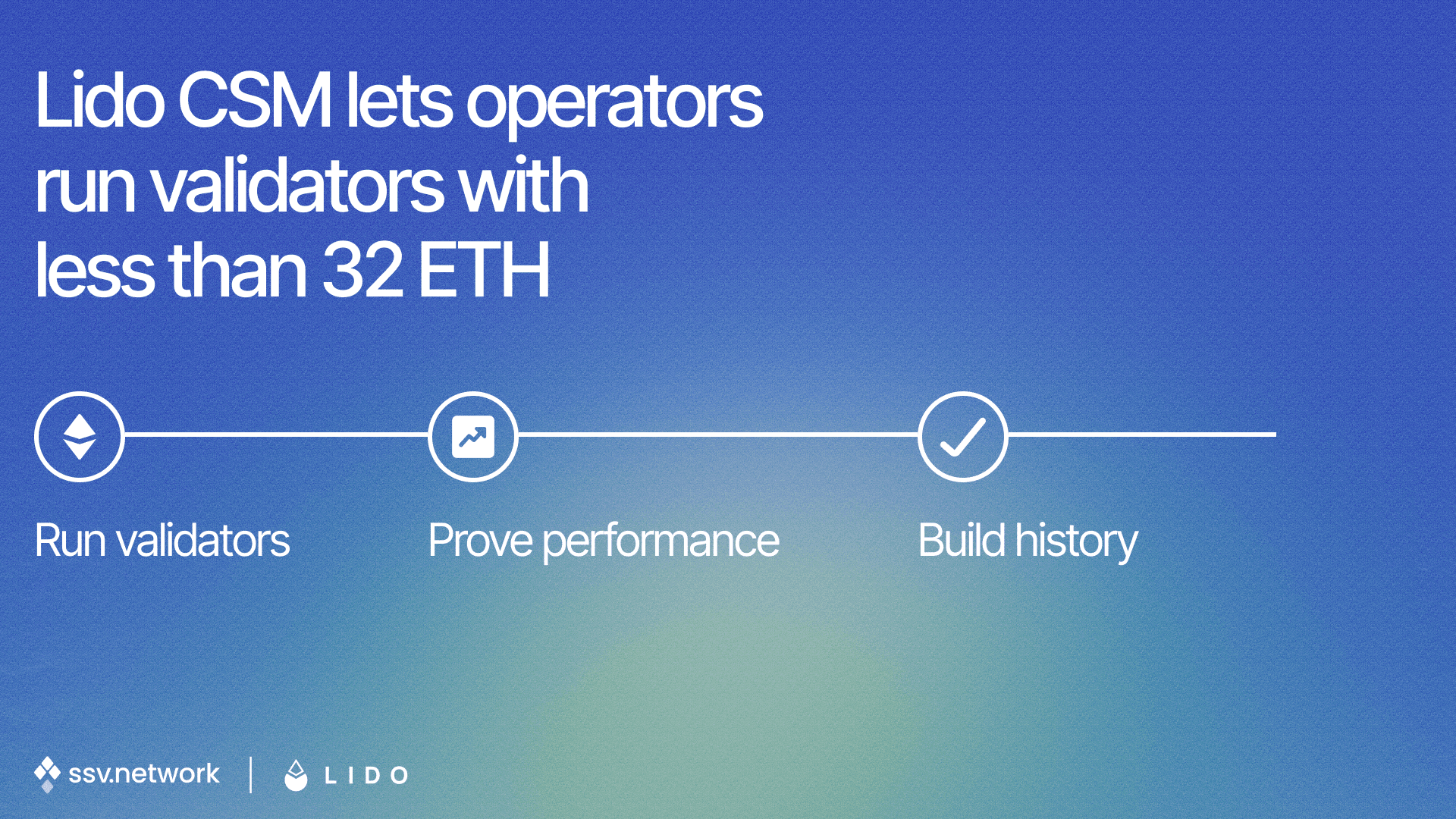
Lido’s Community Staking Module gives independent and community operators a way to run validators using Lido with a lower ETH bond than the full 32 ETH required for solo staking.
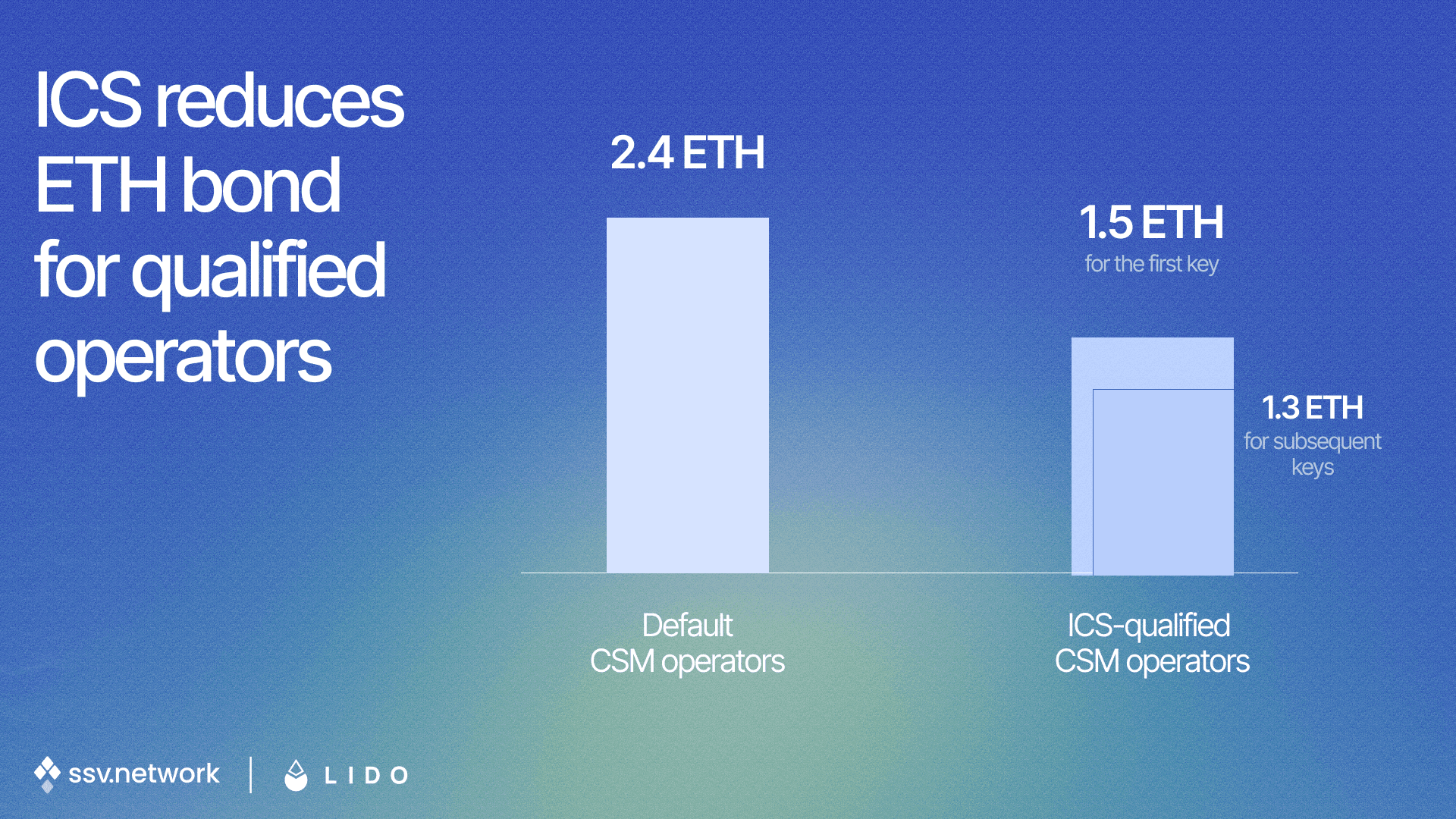
In CSM, default node operators can start with a 2.4 ETH bond for the first validator key. For Identified Community Stakers, the bond is lower: 1.5 ETH for the first key and 1.3 ETH for subsequent keys.
CSM is designed for solo stakers, community stakers, groups of friends, and smaller operators who want a more accessible way to participate in Ethereum validation.
Instead of waiting for a large staker to allocate validators to an unproven operator, the operator can participate in CSM, run validator infrastructure, and start building the performance history needed to become an SSV Verified Operator.
In simple terms:
CSM helps operators get the first validator opportunity.
SSV VO helps operators turn that experience into reputation.
ICS helps recognize that reputation inside Lido’s Identified Community Staking framework.
What is now live
The ICS scoring framework for Lido CSM now includes two SSV-based score sources.
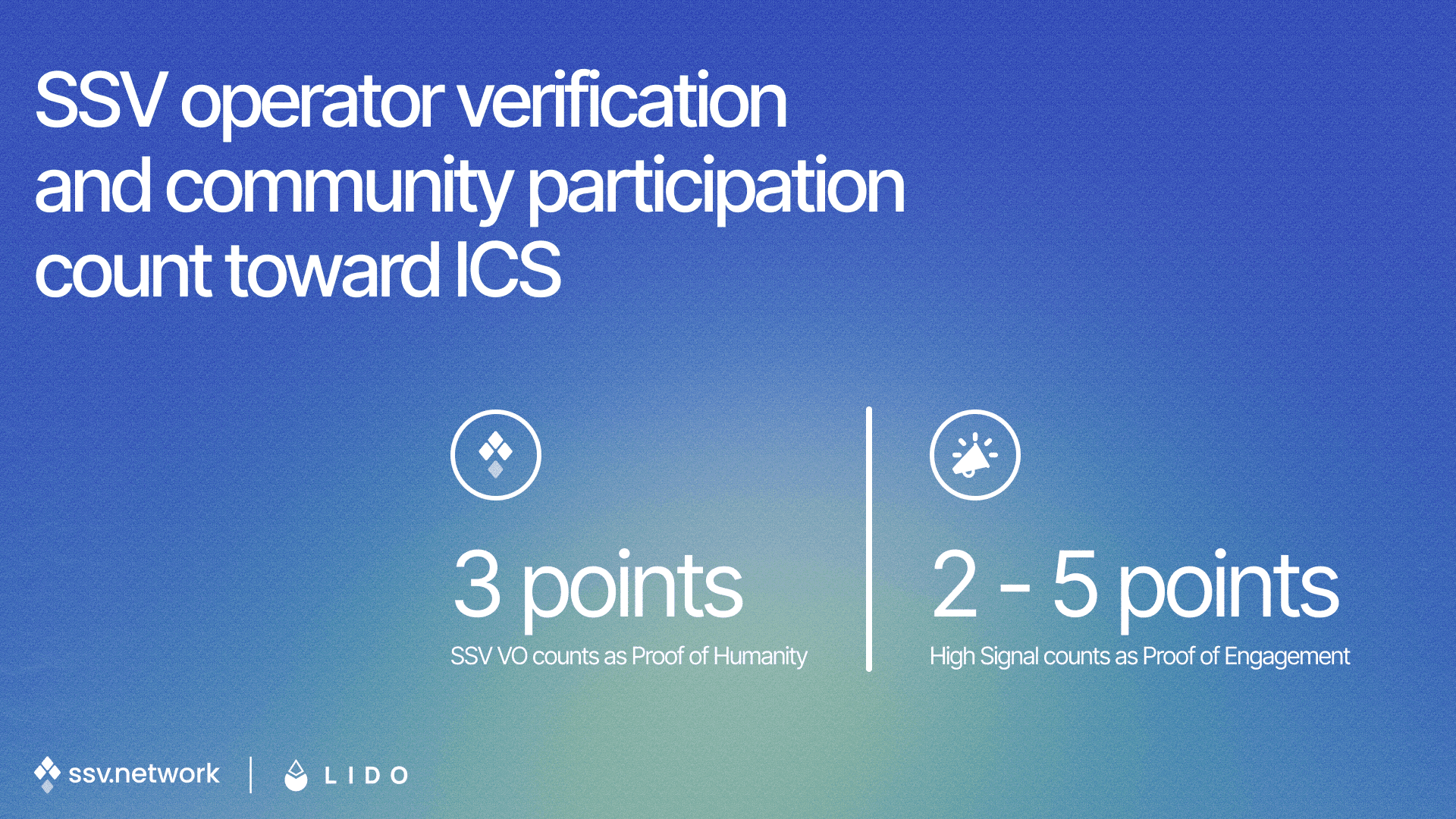
First, SSV Verified Operator status is recognized as a Proof of Humanity source, worth 3 points.
Second, High Signal score can be used as a Proof of Engagement source, worth 2 to 5 points depending on the operator’s score. This can come from the Lido or SSV High Signal space. The two scores are not added together. The higher score is used.
SSV VO already acts as a strong Proof of Experience signal in the ICS framework. With these additions, community operators who become SSV Verified Operators can use their SSV reputation, verification, and community participation as part of their path toward ICS.
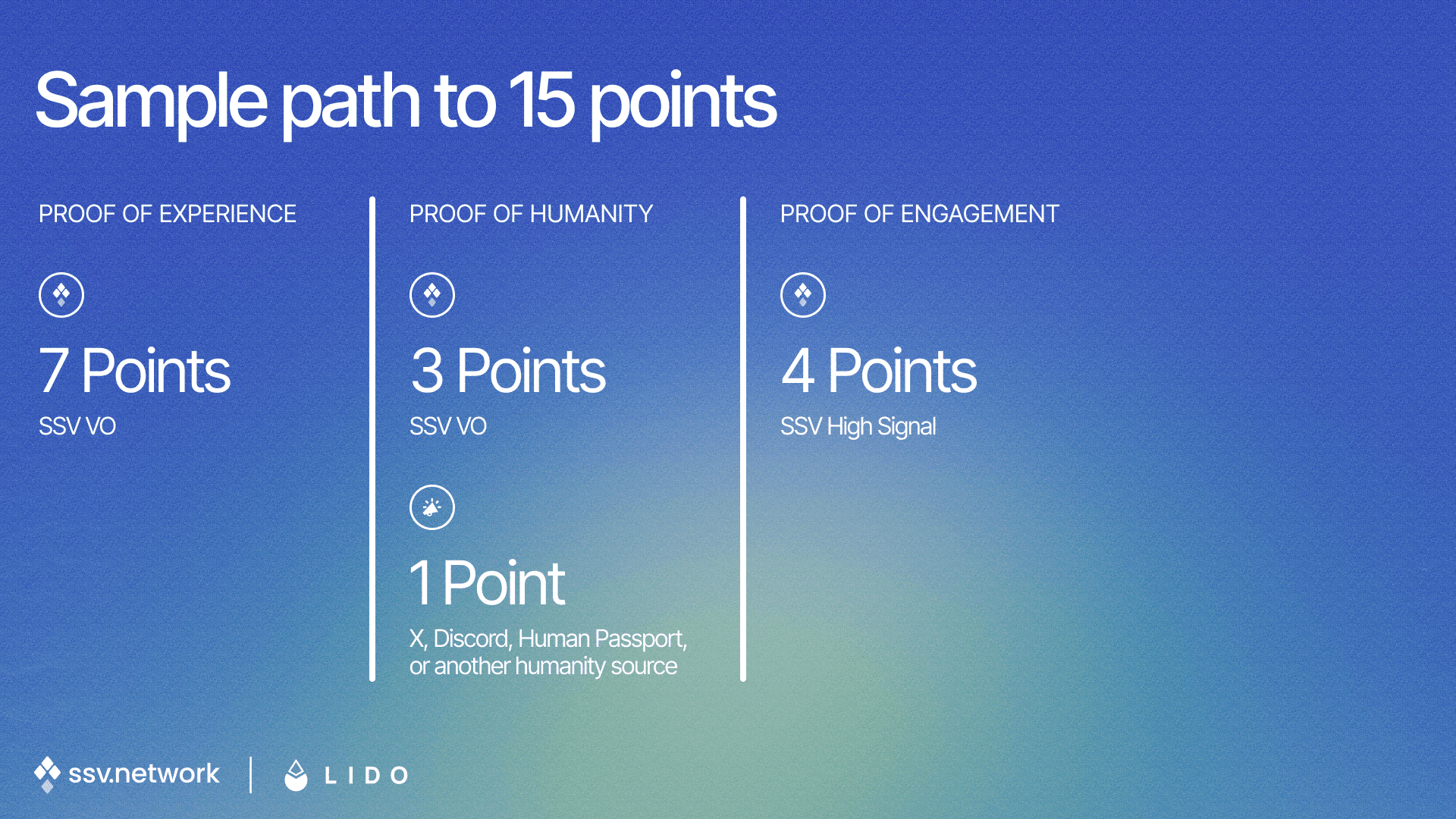
An example could look like this:
SSV VO: 7 Proof of Experience points
SSV VO: 3 Proof of Humanity points
X, Discord, Human Passport, or another humanity source: 1 additional Proof of Humanity point
SSV High Signal: 4 Proof of Engagement points
Total: 15 points.
This still requires multiple independent signals across experience, humanity, and engagement. Operators need to run validators, build mainnet performance history, complete verification, and show real community participation.
The goal is to recognize credible SSV operator signals inside the ICS framework and make the path clearer for community operators who are already doing the work.
What is SSV VO?
SSV Verified Operators are operators reviewed through the SSV DAO’s Verified Operator process.
VO status is meant to help stakers identify operators that have demonstrated operational quality and reliability.
A Verified Operator is not just someone who has registered as an operator on SSV Network. It is an operator that has passed additional review and performance expectations.
To become an SSV Verified Operator, operators need to build real mainnet performance history. For this path, operators are expected to operate an active mainnet validator share for at least 60 days while maintaining strong performance, with the SSV Operator Committee reviewing whether the operator meets the required standard.
Testnet is still strongly encouraged for operators who are new to running validators or DVT clusters. It is a good way to test the setup before real funds are involved.
But the VO clock starts with mainnet activity. Testnet does not count toward earning SSV VO status.
What is Lido ICS?
ICS stands for Identified Community Staker.
It is Lido CSM’s framework for identifying and recognizing community operators based on several categories of proof.
The framework is designed to avoid relying on a single signal. Instead, applicants combine proofs across different categories, including:
Proof of Experience
Proof of Humanity
Proof of Engagement
This makes the framework harder to abuse, while still giving real community operators a path to qualify.
The SSV score sources fit into that structure. SSV VO contributes to Proof of Experience and can also contribute partially to Proof of Humanity. High Signal contributes to Proof of Engagement.
What is High Signal?
High Signal is a reputation system that measures community participation in public spaces such as Discord and forums.
For this path, a High Signal score from the Lido or SSV High Signal space can be used as a Proof of Engagement source for Lido CSM ICS application.
The scoring follows this structure:
2 points if the High Signal score is between 30 and 40
3 points if the score is above 40 and up to 60
4 points if the score is above 60 and up to 80
5 points if the score is above 80
Lido and SSV High Signal scores are not added together. The higher score is used.
This rewards operators who are not only running infrastructure, but also participating in the community, helping others, contributing to discussions and building a visible reputation.
That is important because good operators are not only measured by uptime. They are also measured by how they show up in the ecosystem.
Who this path is for
This path is designed for independent and community node operators.
That includes:
solo stakers
community stakers
smaller operators
SSV operators trying to build mainnet performance history
operators interested in CSM
operators who may later participate in DVT cluster models
It is not designed for large enterprise staking providers or professional organizations that already have mature validator operations and established reputation.
The focus is on capable operators who need a clearer first step.
The operator journey
The journey is simple.
1. Prepare your setup
Before joining mainnet, operators should prepare their validator infrastructure properly.
For newcomers, running on testnet first is recommended. This gives operators a chance to test their setup, tooling, monitoring and DVT cluster coordination before moving to mainnet.
2. Join CSM and run on mainnet
The operator joins Lido CSM and begins running validator infrastructure.
For SSV operators, this can mean participating as part of an SSV-based DVT cluster.
This mainnet activity is the foundation of the path. It gives the operator the real validator performance history needed for SSV VO review.
3. Build mainnet performance history
The operator runs validator infrastructure and maintains strong performance.
For this path, operators need at least 60 days of mainnet validator activity to be eligible for SSV VO review.
This is the part that solves the original circular problem.
The operator gets validator exposure through CSM, uses it to build a performance history and then uses that track record to become a stronger candidate for SSV VO.
4. Become an SSV Verified Operator
After meeting the relevant performance requirements, the operator can go through the SSV VO process.
Once approved, SSV VO becomes the key credential in the ICS path.
It provides:
Proof of Experience in ICS
Partial Proof of Humanity in ICS
A strong reputation signal inside the SSV ecosystem
5. Build High Signal
The operator also builds engagement through the community.
That can include participating in Discord, contributing to discussions, helping other operators and building a public reputation.
A strong High Signal score from the Lido or SSV High Signal space can then count toward Proof of Engagement in the ICS framework.
6. Apply for ICS
With SSV VO, an additional humanity proof and High Signal, the operator can apply for Lido ICS.
The path is not automatic.
Operators still need to meet the framework requirements. But the route is clearer, more realistic and better aligned with how community operators actually build reputation.
Why this matters
For community operators, this creates a more practical way to build reputation and move from “capable but unknown” to verified and visible.
For Lido CSM, it can help bring in more independent operators with real performance history and familiarity with DVT.
For Ethereum, the broader benefit is simple: more high-quality operators, more distributed validator infrastructure, and a stronger staking ecosystem.
Start building your path
The path starts with preparation. The next ICS application review round is expected in early September, giving operators time to prepare, build mainnet history, and complete the required steps.
Start with the docs > Prepare your setup > Join CSM > Run on mainnet > Build performance > Build reputation > Apply for SSV VO > Progress toward ICS
Ethereum needs more high-quality community operators. This is one way to help them get there.
Useful links: