SSV Staking
2/23/26
Unveiling the SSV Staking Testnet & cSSV Alpha Testers Campaign

The SSV Staking testnet is live. Learn how to get test tokens, stake and mint cSSV, claim test ETH rewards, unstake, and join the Early Adopter Campaign.
Call for cSSV testers
The SSV staking testnet is here, and the SSV DAO is calling on you to play a crucial role in this auspicious rollout. SSV Network did not get to where it is today alone; it’s built on decentralized infrastructure, but powered by dedicated builders, node operators, and community members.
Today, SSV DAO calls on you to be the early adopters of SSV staking and provide valuable feedback. Of course, no good deed goes unrewarded in the SSV ecosystem, so the SSV DAO is launching an incentivized Alpha testers program for those who share their experience with the team and the world.
This blog post will cover:
The basics of SSV staking: stake, unstake, and ETH rewards claiming processes.
SSV Staking incentivization program.
How SSV staking works under the hood.
What you need before you start
SSV staking is the entry point to infra rewards for those who support crucial protocol functions, allowing them to claim a portion of the ETH-denominated network fee flow.
Wallet & network
Connect to the staking web app with an Ethereum wallet (e.g., MetaMask).
Add the Hoodi testnet RPC
Get testnet tokens
Testnet tokens have no monetary value, but this test helps harden the system before mainnet.
Getting Started with SSV Staking
Stake
Step 1: Navigate to the SSV staking webapp.
Step 2: Connect wallet (MetaMask, Coinbase Wallet, or WalletConnect).
Step 3: Navigate to the Stake tab
Add the amount of SSV you want to stake.
Click stake.
Approve the spending cap request (permission for the staking contract to move your tSSV).
Confirm the tx request.
Step 4: Mint cSSV
After staking is successful, click “Add cSSV to wallet”.
cSSV balance will show up in your wallet. The cSSV token is a 1:1 representation of your staked position.
cSSV is the UX interface for ETH-denominated rewards: stake SSV, hold cSSV, accrue ETH.
Claim ETH
Rewards accrue to the wallet holding cSSV and can be claimed without unstaking.
To claim your ETH rewards
Click claim all
Confirm the txn
Your ETH will be credited to the wallet automatically
Unstake
Step 1: Request unstake. Your tokens will be locked in cooldown.
Step 2: After completing cooldown, finalize the withdrawal to burn cSSV & get SSV 1:1
Migration & SDK
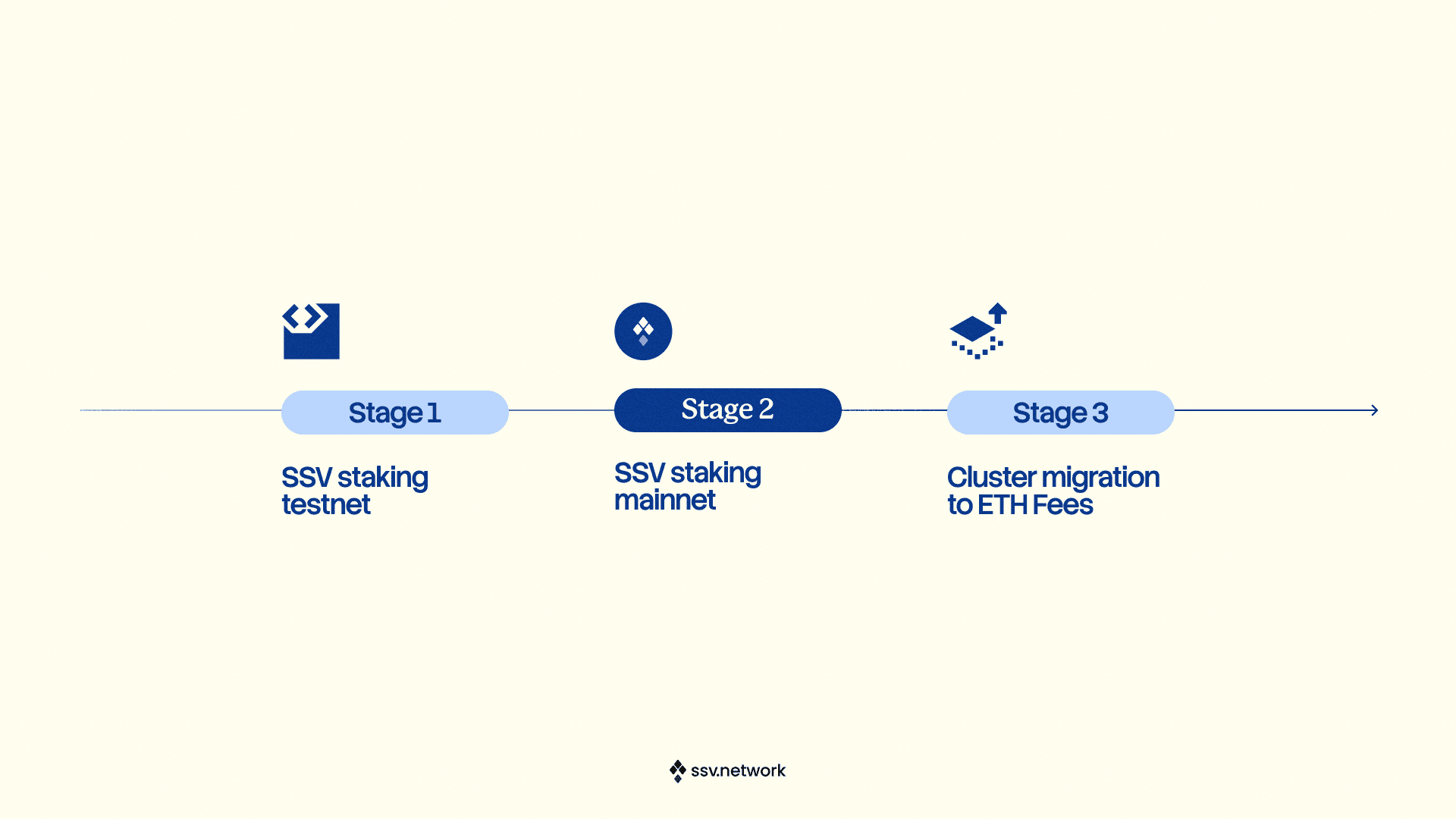
As mentioned in the initial announcement, SSV staking is part of a larger set of protocol upgrades that will require clusters to migrate to ETH-denominated payments. Transitioning clusters to ETH-denominated payments is essential for continued operation as the upgrades go live (pending DAO approval). The migration guide linked below will be your resource to help with the migration.
The SSV SDK has also been updated with new functions to programmatically switch from SSV token fees to ETH, fetch cluster balances, and more to make migrations as seamless as possible.
Migration guide: https://ssv.network/cssv/partners-guide
Testnet SDK for devs: https://github.com/ssvlabs/ssv-sdk/releases/tag/v.1.0.0
SDK docs for installation: https://docs.ssv.network/developers/SSV-SDK/
Alpha Testers Rewards Program: How to join
Now that you understand how the flow works, let's move on to the rewards program and how to participate.
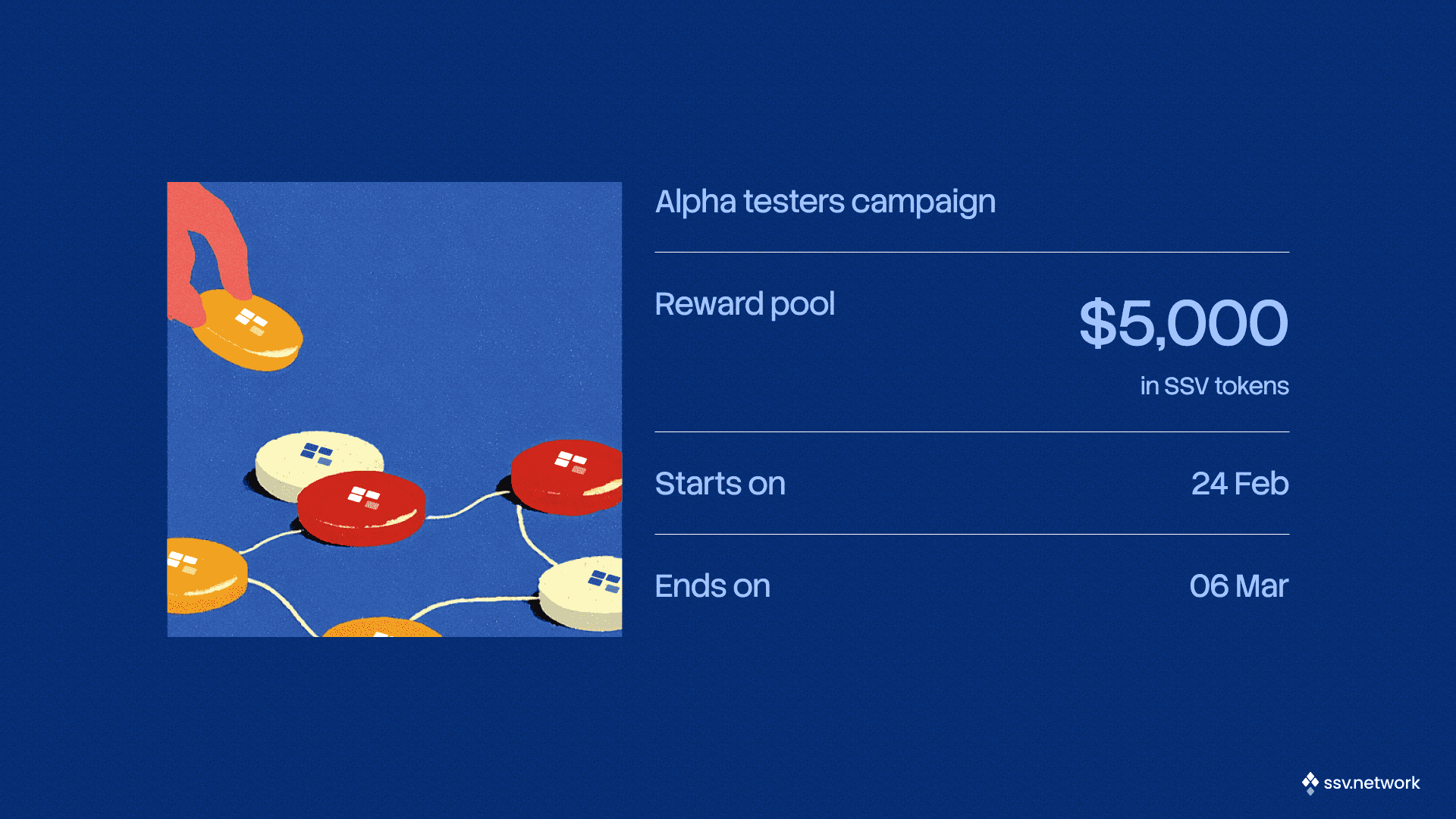
To celebrate testnet go-live, we’re running a 10-day Alpha testers campaign with a $5,000 prize pool focused on high-quality, actionable feedback. The testnet is open to anyone, but if you want to participate in the campaign, there are some rules and eligibility criteria to follow.
Timeline
24 February to 06 March
Reward Pool
$5,000 prize pool in SSV tokens
Reward structure: $100 for 25 eligible participants + $100 bonus for sharing feedback publicly (X / YouTube / blog post).
Claiming Rewards
The SSV DAO will publish a list of winners’ wallet addresses after payouts, ensuring there is no personal identiiabel information attached. Note: Sybil decisions are final to protect the integrity of the program.
Only submissions that pass all eligibility checks, qualification checks, and Sybil checks are included.
Slots (up to 25) are selected on merit-basis for the most useful feedback and/or best educational public content.
Enforce uniqueness: One winner per human identity cluster (wallet + Discord + X + proofs). If a duplicate is found, reroll/reselect.
Eligibility
There are 2 participation levels:
Open participation: Anyone can try the testnet and share feedback.
Rewards-eligible tester:
Single wallet address used throughout the campaign: same 0x wallet for Hoodi testnet interactions and for receiving SSV rewards on ETH mainnet
Holds ≥10 SSV in that same wallet at the registration snapshot (while filling out the interest form) and at the pre-payout snapshot (at rewards payout on mainnet).
Continuous holding requirement: Wallet must have held ≥10 SSV from the time the interest form was filled to the time of mainnet launch.
Wallet maturity: EVM wallet must be ≥30 days old and have ≥10 historical mainnet transactions.
Identity binding: 1 wallet, 1 Discord account, 1 X handle. Note: duplicates disqualify all linked entries.
Discord verification: Discord account must be ≥30 days old and must pass server verification requirements.
Agreement to rules: Sybill automation, multiple wallets, or coordinated farming results in disqualification with no payout.
How to Participate
Testers can fill out the interest form and join the cSSV-testers chat on SSV Network Discord server.
Eligible testers will be added to a private Discord testers group for support and announcements.
Complete all required testnet actions:
Mint testnet SSV
Stake testnet SSV to mint testnet cSSV
Claim testnet ETH rewards to your wallet
Unstake testnet cSSV
Submit the final feedback form by the deadline with required mandatory responses.
Mandatory responses:
Tx hash / explorer link for stake, withdraw, and unstake actions.
Wallet address (must match the wallet shared in the interest form)
Short-answer feedback questions completed.
Qualification for bonus reward:
Publish at least one original post (X thread / Tweet series / YouTube short/video / blog) describing the experience and feedback.
Tag SSV Network handle (@ssv_network); link the post in the feedback form.
Read detailed terms & conditions
Lets get testing!
Understanding SSV Staking Mechanics
Stake
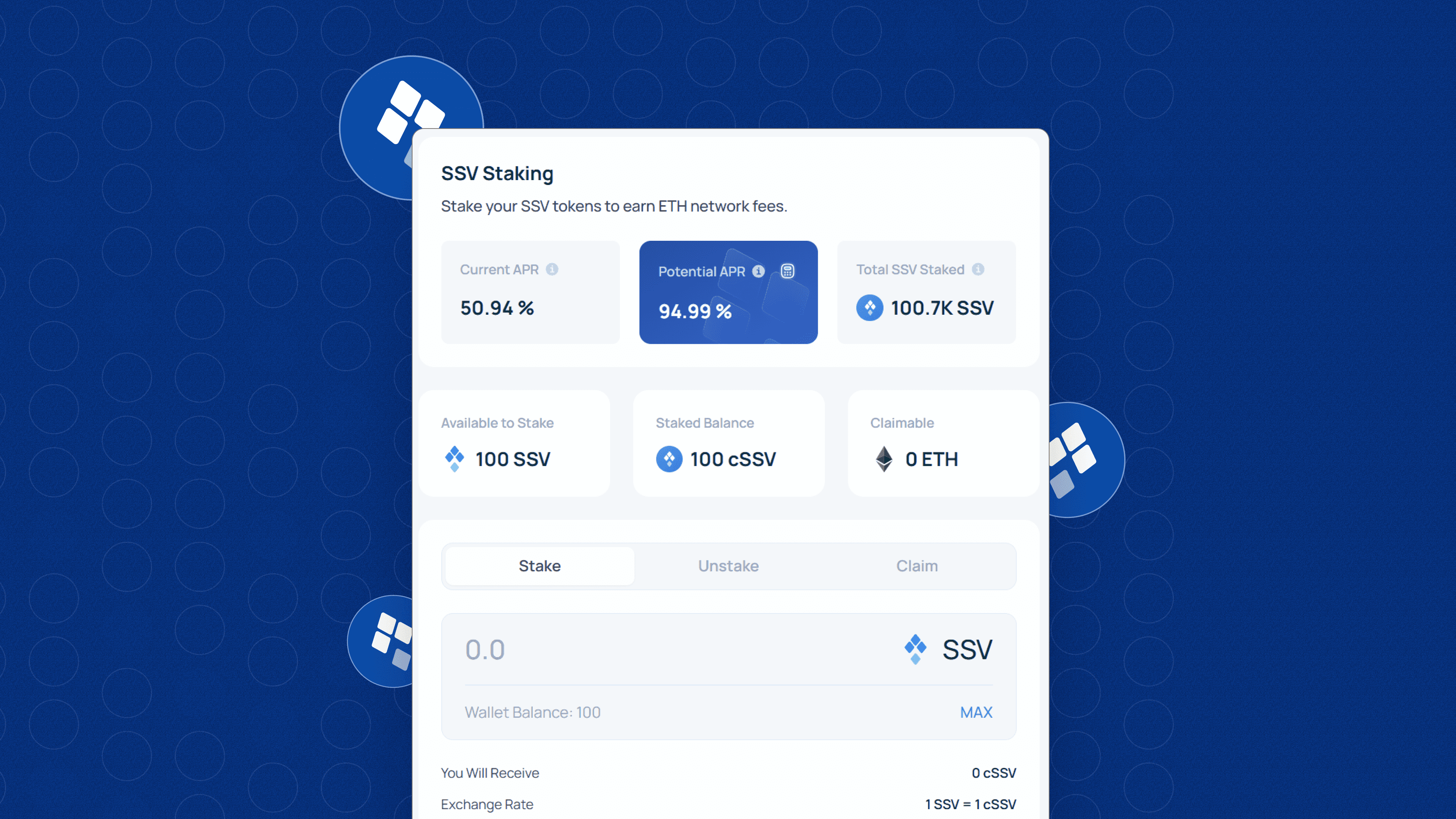
SSV Staking opens up a staking contract for SSV holders to interact with. When you stake any amount of SSV, the contract creates a position that is eligible to receive ETH rewards based on total ETH fees generated by the protocol, your SSV position, and the SSV price. Positions are tracked with a combination of balances and reward indices, similar to how clusters and operators track fees. Rewards are accrued automatically (block by block, as network and operator fees are deducted from the runway balance) to the wallet address holding the cSSV and can be claimed at any time without needing to unstake first.
SSV holders can stake their tokens in the SSV Staking contract and receive cSSV, an ERC-20 token that represents their staked position at a 1:1 ratio. cSSV represents a claim on the underlying staked SSV, as well as a proportional share of protocol fees accrued to stakers (in native ETH).
As part of staking, stakers will be required to delegate their staking voting power. This delegation determines the composition of the Effective Balance Oracle set, which maintains effective balance data on-chain. More on voting will be shared soon.
In the initial phase, staking delegation is automatically split evenly across the DAO-elected oracle set, providing a smooth start while laying the foundation for stake-driven oracle selection in future phases.
Claim
Network fees accrue continuously as operators maintain validators on the SSV Network and generate network fees - these fees are part of the staking rewards. Stakers earn a pro rata share of ETH-denominated fees based on their share of the total staked SSV. Rewards can be claimed at any time without unstaking, and claiming does not affect the staking position. Unclaimed rewards will stay in the claim UI indefinitely until claimed (there is no time limit as of yet and is up to DAO discretion).
When cSSV tokens are transferred, rewards accrued up to that point remain claimable by the original holder, while the new holder begins accruing rewards only from the moment they receive the cSSV.
Unstake
Unstaking is a two-step process:
First, the staker submits a withdrawal request, which locks the specified amount of cSSV and stops reward accrual for that portion. The staking UI will launch with a DAO controlled 7-day cooldown period which refrashes after claiming.
Once the cooldown period ends, the staker can finalize the unstake. The locked cSSV is burned, and the underlying SSV is returned at a 1:1 ratio.
Unstaking is handled via a queue. When a staker requests to exit, their position moves into a pending state where it no longer accrues rewards. After a DAO-predefined delay, the staker can claim their SSV. This delay stabilizes the system by preventing abrupt in-and-out behavior around known reward events and by giving the protocol time to adjust parameters or respond to large shifts in total staked SSV.
Governance and Parameter Control
SSV Staking introduces new governance levers. The DAO can set or adjust the buffer threshold for EB updates, define parameters around liquidation collateral, and configure how much of the protocol’s ETH fee income is routed into the staking reward pool versus retained for other purposes (i.e., storing it in the treasury).
At the same time, staked SSV continues to represent governance power. Holding and staking SSV allows participants to vote on proposals. This helps ensure that the people who benefit from SSV Staking are also those who help steer its evolution.
Let’s get testing!
Join the testnet, share your feedback, and lets get staking!
Disclaimer: The above represents a vision for the future of SSV Network and is subject to approval by the SSV DAO.